Pearson Edexcel · GCSE · Psychology
Course version: 1PS0 · Version from Sept 2017
Know the terms: a. obedience b. conformity c. deindividuation d. bystander…
Full specification wording
Social influence: 5.1.1 Know the terms: a. obedience b. conformity c. deindividuation d. bystander effect
Social influence explores how individuals' thoughts and actions are altered by others.
Checked against the Pearson Edexcel 1PS0 specification (opens in a new tab) on .
- Point 1 of 6
- 4 key terms
Study notes
From the checked teaching notes for this specification point.
The idea
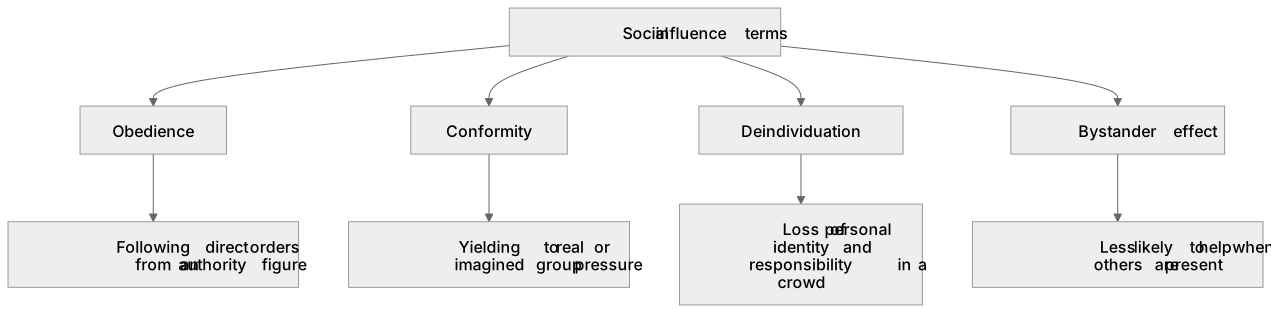
Social influence explores how individuals' thoughts and actions are altered by others. Obedience involves following direct orders from a perceived authority figure, such as a student obeying a headteacher. Conformity is yielding to real or imagined group pressure, changing behaviour to fit in with a majority, like adopting a fashion trend. Deindividuation occurs when individuals lose their sense of personal identity and responsibility within a crowd, often leading to uncharacteristic or anti-social behaviour, such as rioting. The bystander effect is the phenomenon where a person is less likely to provide help in an emergency when other people are present, assuming someone else will intervene, such as ignoring a collapsed pedestrian on a busy street.
What earns the marks
- Define obedience as following direct instructions from an authority figure.
- Define conformity as changing behaviour or beliefs to align with a group majority.
- Define deindividuation as the loss of personal identity and accountability in a group setting.
- Define the bystander effect as the reduced likelihood of helping a victim when others are present.
Common mistakes and how to put them right
Confusing obedience and conformity.
Put it right: Obedience involves a direct order from an authority figure, whereas conformity involves yielding to peer pressure without a direct command.
Misunderstanding deindividuation: Students often think it just means being in a group, but it specifically requires a loss of personal identity and a reduced sense of individual responsibility.
Misinterpreting the bystander effect: Assuming it means people never help in crowds; it actually means the probability of any one individual helping decreases as the number of bystanders increases.
Exam tips
- Use clear, distinct examples for each term to demonstrate your understanding in applied questions.
- When defining conformity, ensure you mention that the pressure can be real or imagined.
- Look out for multiple-choice questions that describe a scenario and ask you to identify which of the four terms is being demonstrated.
Try the lesson
The start of the Social influence: 5.1.1 Know the terms: a. obedience b. conformity c. deindividuation d. bystander effect lesson, made from checked teaching notes for this specification point.
Have a go first
Which of the following best describes the psychological concept of conformity?
Listen
Social influence explores how individuals' thoughts and actions are altered by others. Obedience involves following direct orders from a perceived authority figure, such as a student obeying a headteacher. Conformity is yielding to real or imagined group pressure, changing behaviour to fit in with a majority, like adopting a fashion trend. Deindividuation occurs when individuals lose their sense of personal identity and responsibility within a crowd, often leading to uncharacteristic or anti-social behaviour, such as rioting. The bystander effect is the phenomenon where a person is less likely to provide help in an emergency when other people are present, assuming someone else will intervene, such as ignoring a collapsed pedestrian on a busy street. A strong answer earns marks for these points. Define obedience as following direct instructions from an authority figure. Define conformity as changing behaviour or beliefs to align with a group majority. Define deindividuation as the loss of personal identity and accountability in a group setting. Define the bystander effect as the reduced likelihood of helping a victim when others are present. Exam tip: Use clear, distinct examples for each term to demonstrate your understanding in applied questions.
See it
Key words
Say what each word means before you turn the card.
Obedience
Try answering aloud or in your head before turning the card.
Conformity
Try answering aloud or in your head before turning the card.
Deindividuation
Try answering aloud or in your head before turning the card.
Bystander effect
Try answering aloud or in your head before turning the card.
See every definition
- Obedience
- Following direct orders from a perceived authority figure, such as a student obeying a headteacher.
- Conformity
- Yielding to real or imagined group pressure, changing behaviour to fit in with a majority, like adopting a fashion trend.
- Deindividuation
- Losing one's sense of personal identity and responsibility within a crowd, often leading to uncharacteristic or anti-social behaviour, such as rioting.
- Bystander effect
- Being less likely to provide help in an emergency when other people are present, assuming someone else will intervene, such as ignoring a collapsed pedestrian on a busy street.
Label the diagram
Some boxes have lost their names. Pick the right name for each number.
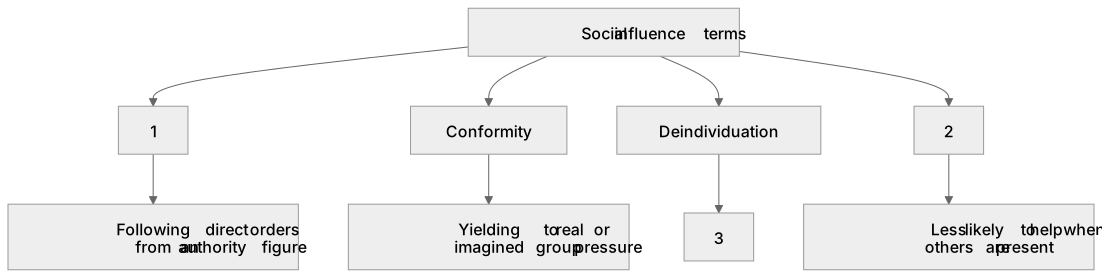
1Box 1
2Box 2
3Box 3
There is more to this lesson
The full lesson goes on to check your understanding and help you earn the marks. Create a free account to carry on, with your progress saved.
A week of Premium from your first lesson · Then the free plan continues · No card, no charge
Test your understanding of Social influence: 5.1.1 Know the terms: a. obedience b. conformity c. deindividuation d. bystander effect
Active recall beats re-reading. Take an instant quiz now to test what you’ve learned and lock it into long-term memory.
A week of Premium from your first lesson · Then the free plan continues · No card, no charge